
The Real Reason You Freeze On Camera
Sep 15, 2026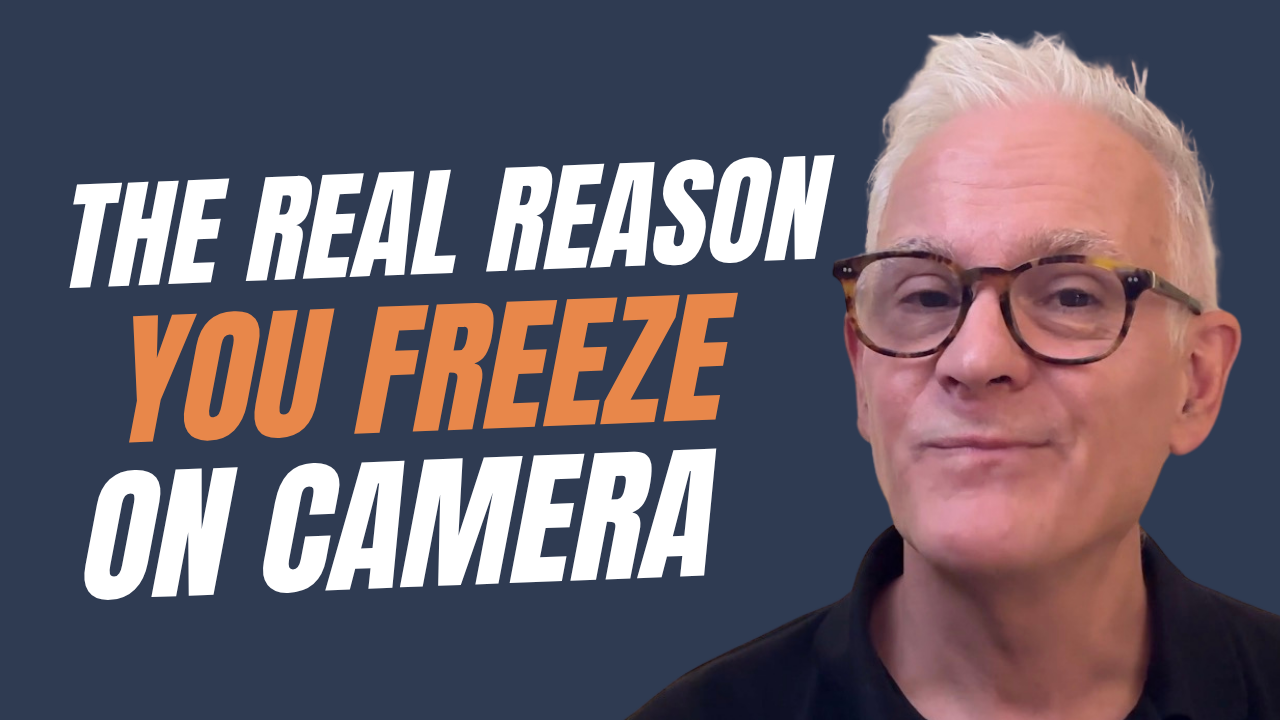
You know your stuff. You've been coaching, training and helping people, sometimes for years. And yet the moment you hit record, something happens. Your mind goes blank, you stumble over words you'd normally say without thinking, and the version of you that shows up on screen feels nothing like the person your clients actually know.
Most people assume it's a confidence problem. That some people are just naturally good on camera and others aren't. That if you were only more confident, more experienced, more comfortable in yourself, it would all just click.
But I don't think that's what's going on.
I've worked with coaches and experts who are brilliant in a room. People who present to hundreds, who hold space for clients through incredibly difficult conversations, who are articulate, warm and completely compelling in person. And they still freeze on camera.
So it isn't a confidence problem. It's what I call a context problem.
The camera creates a situation your brain has never been trained to handle. And until you understand what's actually happening, no amount of confidence-building is going to fix it.
I know this from experience. I spent twenty years performing as a singer and songwriter, in clubs, bars and the occasional room that was more empty than full. That repetition taught me to show up in front of people even when part of me wanted to disappear. And somewhere along the way, my stutter lost its grip too.
So when I moved into coaching and training, I felt comfortable in front of an audience. And then I got in front of a camera for the first time to make a video for my business. My mouth went dry. I started talking twice as fast as normal. My mind went blank mid-sentence. And when I watched the footage back, I noticed things I hadn't even been aware of at the time: blinking too much, a twitch in my shoulders, trying to stand still and look relaxed and doing neither.
Twenty years of performing in front of people. None of it had prepared me for this.
Because a camera isn't an audience. It's something else entirely.
In my experience, overcoming the camera freeze comes down to two things: the inner game (what you're telling yourself before, during and after filming) and the outer game (the practical strategies that help you feel comfortable and in control). Neither works without the other. But both are learnable.
If you want to find out where to start, the free Camera Confidence Self-Assessment is linked below. It takes a few minutes and shows you exactly where to focus first.
You know your stuff. But something happens when the camera comes on.
Find out what is really getting in the way. Take the free Camera Confidence Self-Assessment to spot the specific pattern that makes you freeze, overthink, or lose your natural voice on video.
