
The Real Reason Capable Experts Still Freeze On Camera
Jul 14, 2026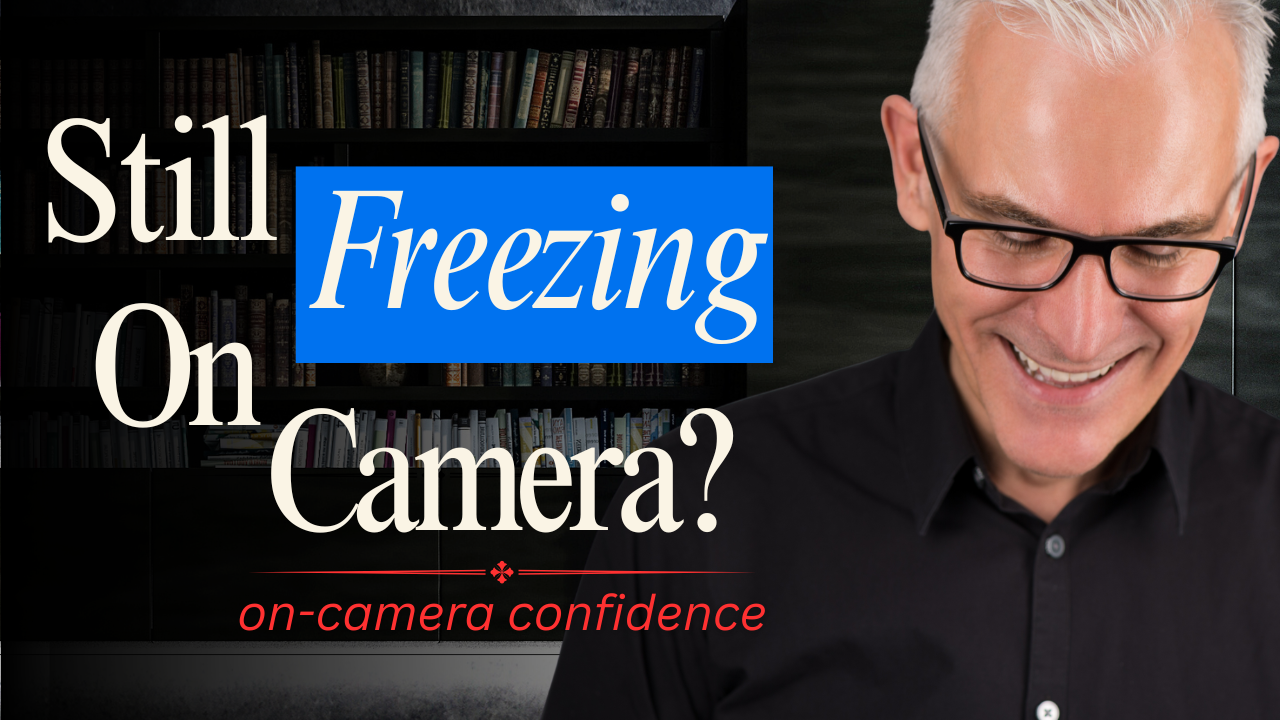
Here's something I see constantly with coaches and experts who come to me for help: they are brilliant in the room. Ask them a question and they'll give you a clear, generous, considered answer. Put them in front of a client and they light up. But put a camera in front of them, and something changes.
The shoulders tighten. The sentences shorten. The warmth that's there in every other part of their life goes missing. And afterwards, they'll tell me the same thing almost word for word: "I know my stuff, I just don't come across like myself."
That line is the whole problem, and also the whole solution.
It's not a skills gap, it's a permission gap
Most people assume that on camera confidence is a performance skill you either have or don't. Learn to speak slower, learn to smile more, learn the tricks. I understand why people think that way, because it's how I used to think too.
I spent years learning to manage a stammer, and the thing that actually changed everything wasn't a technique. It was singing. Something about a melody gave me permission to stop monitoring every word before it left my mouth. I wasn't performing confidence, I was simply no longer blocking myself from it. Years later, after a long career as a singer and songwriter, I noticed the exact same pattern showing up in clients who'd never had a speech difficulty in their life.
They weren't lacking skill. They were lacking permission to be seen as themselves, at full volume, without editing it down first.
Why this shows up more with experts, not less
You'd think the more experienced or ‘expert' someone is, the easier this gets. Often it's the opposite. Expertise brings a quiet, constant pressure to be right, to be polished, to not waste anyone's time. On camera, with no live audience to read and adjust to, that pressure has nowhere to go. So people tighten up instead of opening up, and the version of them that shows up on screen is smaller and more guarded than the version their clients actually hire.
If you've ever watched your own video back and thought "that's not really me," this is very likely what's happening. Not a lack of ability. A lack of permission to let the real, slightly rough, entirely credible version of you be the one that's visible.
What actually helps
A few reframes I share with clients, that tend to shift things faster than any technical fix:
- You don't need to sound like a broadcaster. You need to sound like the best version of how you already talk to a client you trust.
- Confidence on camera is rarely built by practising more takes. It's built by lowering the bar for what "good enough to post" means, so you actually get reps in.
- The nerves don't need to disappear before you start. They just need to stop being the loudest voice in the room.
None of this is complicated. But it is very hard to see clearly on your own, because the pattern is usually invisible to the person living inside it. That's exactly the kind of thing a second pair of eyes, and a bit of structured space, is good for.
If this sounds familiar
If you recognised any of this, that quiet gap between how capable you are and how you actually come across on camera, I'd like to invite you to a free discovery call.
It's thirty minutes, no pitch, no pressure. Just a proper conversation about where the gap is for you specifically, and whether working together makes sense. Some people leave that call with a plan they run with on their own. Others decide to work with me. Either way, you'll leave with more clarity than you came in with.
Book your free discovery call HERE
If you've been putting off showing up on camera the way you actually deserve to, this is a good, low pressure place to start.
You know your stuff. But something happens when the camera comes on.
Find out what is really getting in the way. Take the free Camera Confidence Self-Assessment to spot the specific pattern that makes you freeze, overthink, or lose your natural voice on video.
