
Camera Confidence Isn't a Personality Trait.
Sep 23, 2026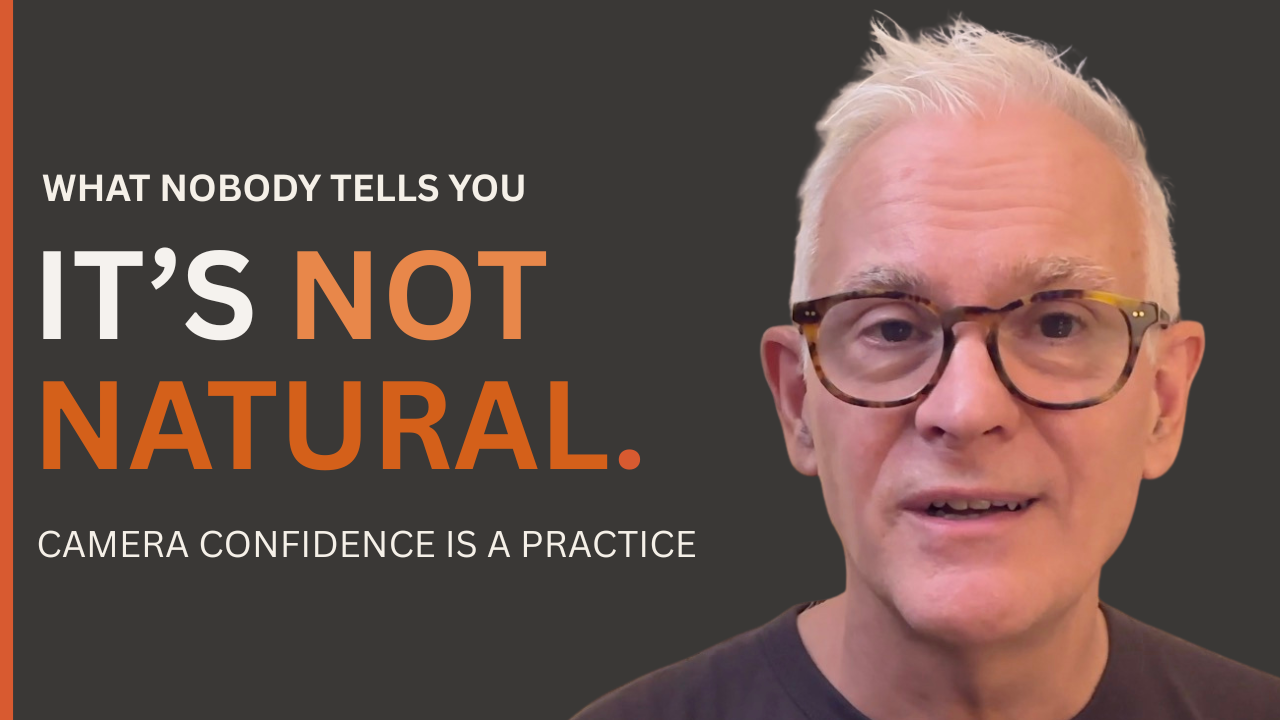
Have you ever watched someone on camera and thought: I could never do that?
That ease. That presence. The way they look like they were just born to be in front of a lens.
I used to think the same thing. And I spent over 20 years performing on stage as a singer and coach before I figured out why that assumption is wrong.
Here's what nobody tells you: the people who look naturally confident on camera almost never are. They've simply learned something that you haven't been shown yet.
The myth worth letting go
Camera confidence is not a personality type. Introverts can be brilliant on camera. Extraverts can be awkward on it. Personality has very little to do with it.
What looks like natural confidence is almost always the result of two things being done consistently, before anyone presses record. I call them the Inner Game and the Outer Game.
The Inner Game
Before I record any video, I make a decision. Not about the content. Not about the lighting. I decide who I'm going to be in that video.
Not my entire brand or personality. Just: who am I showing up as right now, for this specific video?
For the video I published this week, I decided to be upbeat. Like a supportive colleague sitting across from you, someone who's genuinely on your side. That one decision shaped everything: my energy, my pace, my expression, before I'd said a single word.
Most people skip this entirely. They sit down, press record, cross their fingers, and wonder why the video technically looks fine but somehow doesn't connect. That's what happens when presence is left to chance.
The Inner Game is why presence happens. Decide who you're going to be before you record. That's where it starts.
The Outer Game
Once the Inner Game is set, the Outer Game removes friction. It's a checklist, and it matters because anything that pulls you out of the zone will show up on screen.
Here's mine:
- Background. Is it tidy? Is it intentional? Does it say something about who you are?
- Lighting. One good light source in front of you, or just off to the side, is usually enough.
- Microphone. Switched on, positioned correctly, levels checked. Too close distorts, too far and you sound like you're recording in a tunnel.
- Camera height. Lens at eye level. Too low and you're talking up to your viewer. Too high and you're talking down to them. At eye level, you're talking with them.
- Rehearsal. Not memorising a script. Just running through the shape of what you're going to say two or three times, until it feels familiar in your body.
When the technical environment feels right, the mental environment settles too.
The mistake most coaches make
They do the Outer Game. They sort the background, check the lighting, position the camera perfectly. And then they press record without doing the Inner Game first.
They look set up. But they don't look present.
The sequence matters. Inner Game first. Outer Game second. In that order, every time.
What this actually means for you
Camera confidence comes down to two decisions before you press record:
Who are you going to be in this video? And is everything set up to support that?
That's it. Not talent. Not a personality type. Two decisions, made consistently, before you begin.
If you want to see the full framework in action, I've covered both the Inner Game and the Outer Game in this week's video. https://youtu.be/Uc7iGEa2BdQ
And if you'd like the checklist to keep beside you every time you record, I've put it into a free guide. Just click the link immediately below this Blog post.
You know your stuff. But something happens when the camera comes on.
Find out what is really getting in the way. Take the free Camera Confidence Self-Assessment to spot the specific pattern that makes you freeze, overthink, or lose your natural voice on video.
